


Catalog Products

- News Center:
- Home>
- News Center>
- Company News>
- News Details
Hot Product | H-Pro-AMC Fluorescent Substrate for Prolyl Aminopeptidase Activity Assays
2026/2/11 16:18:56 Browse volume(384)H-Pro-AMC
Proline-specific peptidases are a key class of enzymes responsible for processing proline-containing peptides and proteins. Due to the unique pyrrolidine ring structure of proline, which creates conformational constraints and hinders cleavage by common proteases, the presence of specific enzymes such as prolyl aminopeptidase (PAP) and fibroblast activation protein (FAP) is crucial. These enzymes not only govern the maturation and degradation of bioactive peptides but are also deeply involved in processes like tumor microenvironment remodeling, tissue fibrosis, and immune regulation, making them important targets in current enzymology research and drug development.
Commonly used peptidase activity detection methods include colorimetric assays (e.g., using p-NA substrates) and fluorescent assays (e.g., using AMC substrates). Among these, fluorescent substrates based on 7-amino-4-methylcoumarin (AMC) offer advantages such as high sensitivity, high signal-to-noise ratio, and real-time dynamic monitoring, and are widely used in in vitro enzyme activity analysis, inhibitor screening, and pharmacological research.
This issue introduces H-Pro-AMC—a high-quality AMC fluorescent substrate for proline-specific proteases. We provide both the hydrobromide salt form (H-Pro-AMC·HBr) and the free base form. It is available from stock and supports custom packaging to meet various experimental needs, helping your research work progress efficiently.


Chinese Name: L-Proline 7-amido-4-methylcoumarin hydrobromide
English Name: L-Proline 7-amido-4-methylcoumarin hydrobromide
Abbreviation: H-Pro-AMC HBr
CAS Number: 115388-93-7
Molecular Formula: C15H17BrN2O3
Molecular Weight: 353.22
Specifications: 100 mg / 500 mg / 1 g (Custom packaging supported)
Form: Lyophilized powder
Product Number: G12060007
Color: Blue fluorescence
Stock: In stock
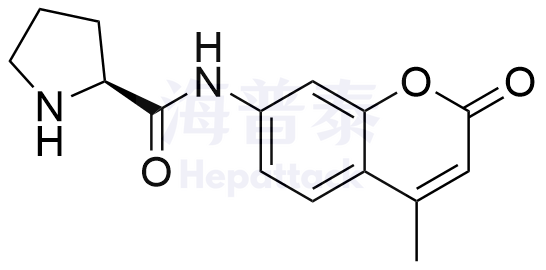
Chinese Name: (2S)-N-(4-methyl-2-oxo-2H-1-benzopyran-7-yl)-2-pyrrolidinecarboxamide
English Name: L-Proline 7-amido-4-methylcoumarin
Abbreviation: H-Pro-AMC
CAS Number: 96643-94-6
Molecular Formula: C15H16N2O3
Molecular Weight: 272.30
Specifications: 100 mg / 500 mg / 1 g (Custom packaging supported)
Form: Lyophilized powder
Product Number: G12060008
Color: Blue fluorescence
Stock: In stock
H-Pro-AMC belongs to the AMC (7-amino-4-methylcoumarin) fluorescent substrate series. In the substrate molecule, L-proline is connected via an amide bond to the 7-amino group of AMC, quenching the AMC fluorophore due to acylation, rendering the substrate itself nearly non-fluorescent.
When proline-specific proteases (such as PAP, FAP, etc.) recognize the free proline residue at the N-terminus of the substrate and hydrolyze the amide bond between Pro and AMC, free AMC is released. The restoration of the free 7-amino group produces an intense blue fluorescence signal (Ex 360 nm / Em 460 nm). The fluorescence intensity is proportional to enzyme activity, enabling real-time continuous kinetic monitoring.
✅ High Sensitivity
The released AMC fluorescent signal after substrate hydrolysis is strong with low background, suitable for low-abundance enzyme activity detection and kinetic analysis.
✅ High Specificity
With proline as the recognition group, it is more suitable for proline-related peptidase systems and can be used for zymography analysis and inhibitor differentiation design.
✅ Dual Forms Available
The HBr salt form is suitable for aqueous systems, while the free base form is suitable for organic solvent systems.
✅ Multipurpose
Suitable for enzyme kinetic studies, inhibitor screening, drug development, and research on the function of tumor-related proteases.
✅ In Stock
Ample inventory allows for quick delivery to meet research and production schedule needs.
• Enzymology and Biology Research: Precisely determine prolyl aminopeptidase (PAP) activity and study its function in protein metabolism and signal transduction.
• Diagnostic Tool Development: Serves as a core raw material for research and development of detection methods and enzyme activity assay kits.
• Fibrotic Disease Research: Used for detecting proline-related peptidase activity, supporting fibrosis mechanism studies and drug screening.
Q1: What is H-Pro-AMC? Which enzymes does it detect?
A: H-Pro-AMC is an AMC fluorescent substrate that releases a highly sensitive fluorescent signal upon enzymatic cleavage. It is primarily used to detect:
• Prolyl Aminopeptidase (PAP): Specifically cleaves N-terminal proline.
• Fibroblast Activation Protein (FAP/Seprase): A key marker enzyme in the tumor microenvironment.
• Dipeptidyl Peptidase family-related enzymes (e.g., DPP-IV): Requires the use of inhibitors for differentiation.
• Prolyl Endopeptidase (PEP/PREP): Can hydrolyze this substrate under specific conditions.
Q2: What is the difference between H-Pro-AMC HBr (115388-93-7) and H-Pro-AMC (96643-94-6)?
A: The core active component is the same; the difference lies in the salt form.
• H-Pro-AMC is the free base, more hydrophobic, and must first be dissolved in DMSO or DMF.
• H-Pro-AMC HBr is the salt form, typically more convenient for preparing working solutions in aqueous buffer systems, reducing the need for organic solvents. For most biological enzyme activity assays, the HBr salt form is recommended for easier operation and to avoid potential inhibition of enzyme activity by high concentrations of organic solvents.
Q3: What are the excitation and emission wavelengths for the AMC substrate?
A: The free AMC released after enzymatic cleavage produces blue fluorescence:
• Excitation Wavelength (Ex): Approximately 360 nm~380 nm.
• Emission Wavelength (Em): Approximately 440 nm~460 nm.
Q4: How specific is this substrate? Can it differentiate between different proline enzymes?
A: H-Pro-AMC is a broad-spectrum proline N-terminal substrate; PAP, FAP, and POP (prolyl oligopeptidase) can all hydrolyze it. To differentiate specific enzyme activities (e.g., distinguish FAP from DPP-IV), it usually requires the use of specific enzyme inhibitors (such as Z-Pro-Pronal) or experimental design using different pH conditions.
Q5: How to detect fluorescence in experiments?
A: After the substrate is hydrolyzed by the enzyme, releasing AMC, real-time signals can be monitored using a fluorescence spectrophotometer or a multi-functional microplate reader with appropriate excitation/emission wavelengths. The rate of fluorescence increase is positively correlated with enzyme activity.
Q6: Is this product suitable for developing detection kits?
A: Highly suitable. This product offers high batch-to-batch stability, low background fluorescence, and excellent signal-to-noise ratio, making it an ideal core raw material for developing prolyl aminopeptidase/FAP activity detection kits, especially suitable for high-throughput drug screening kits and research-use enzyme activity assay kits.
Q7: What about product safety?
A: For research use only. Not for human use, clinical diagnosis, or animal therapy. Please wear appropriate protective equipment according to chemical safety operating procedures during experiments, and avoid direct skin/eye contact.
Q8: What packaging specifications are available? Is customization supported?
A: Three standard specifications are available: 100 mg (trial), 500 mg (regular), and 1 g (large scale). Custom packaging is supported (5 g, 10 g, 50 g, even kilogram scale) to meet different R&D or production stage needs. Custom services and custom synthesis of other amino acid-AMC substrates in the same series are also available.

Extended Services
Change begins with choosing a stable and reliable substrate. We sincerely invite you to experience the excellent performance of the new domestic force.
For more fluorescent/chromogenic substrates or custom packaging services, please call +86-13302967066!
Hepattack Bioscience & Technology is dedicated to providing reliable domestic alternative solutions for gene sequencing, molecular diagnostics, and microbial detection.
For related products such as blood cell dyes and buffer salts, you can view the complete product line and technical specifications on [MedSun Biotechnology Website].
Founded in 2015, it is a high-tech enterprise focusing on microbial testing、 gene sequencing and in vitro molecular diagnostics in the R&D, production, and sales of biochemical reagent raw materials. Committed to providing high-quality biochemical reagent raw materials and professional custom synthesis services, the product portfolio covers more than a dozen categories and nearly a thousand innovative products. Upholding the core philosophy of “customer first, integrity and professionalism”, we serve with dedication to meet customers’ diverse needs in research and testing.

Official WeChat account: Shenzhen Hepattack Bioscience & Technology Co. Ltd.
Official Website: http://www.hepattack.com
Hotline: +86 0755-23251735
QQ: 2370561481
Email: sales@hepattack.com
Related Links
- · FAQs about Hepattack BioTech [2025-01-20]
- · In Stock | Yeast Two-Hybrid Screening Made Easy — X-α-Gal Turns Positive Clones Blue [2026-09-09]
- · In Stock | Magenta-Gal: A Magenta β-D-Galactosidase Chromogenic Substrate for Instant Identification of Positive Clones [2026-09-11]
- · Hot Product | Principles and Applications of S-2366 (Pyr-Pro-Arg-pNA) for Coagulation Factor FXIa Activity Detection [2026-09-15]
- · In Stock | Rapid Visual Detection of Cronobacter in Infant Formula Milk Powder: Domestic X-α-Glc Solution [2026-09-18]
- · Double Holiday Approaching: Have You Arranged Your Orders? Hepattack Holiday & Shipping Notice [2026-09-22]
- · In Stock | Key Raw Material for Salmonella Chromogenic Media: Application Analysis of Magenta-Caprylate [2026-09-30]
- · In Stock | Hard to Tell Colony Morphologies Apart? Butyrate Esterase Detection Adds Another Discriminating Dimension [2026-10-10]