


Catalog Products

- News Center:
- Home>
- News Center>
- Company News>
- News Details
In Stock | Mechanism of 3′-O-N3-dUTP: Why Reversible Terminator Nucleotides are the Core Substrates for SBS Sequencing?
2026/8/21 11:34:07 Browse volume(149)3′-O-N3-dUTP
I. Stopping DNA is not difficult

In the early days of DNA sequencing, scientists quickly realized a problem: if the polymerase continues to extend the DNA strand, the sequencing system cannot accurately determine which base was incorporated at each step.
Thus, a simple and direct idea emerged: stop the DNA chain immediately after each incorporation.
The ddNTPs used in Sanger sequencing are a classic example of this concept. Because ddNTPs lack a 3′-OH, incorporation leads to irreversible termination. However, a new problem arises: although DNA stops, it can no longer extend.
For high-throughput sequencing that requires hundreds or thousands of cycles, mere "termination" is far from enough. The truly ideal state should be:
• Precise termination when needed
• Gentle recovery after signal readout
• After recovery, subsequent polymerization is not affected and the natural DNA structure is preserved
Thus, "reversible terminators" became an important direction in sequencing chemistry. Various 3′-OH blocking strategies were developed, including 3′-ONH₂, 3′-O-Allyl, and 3′-O-Azidomethyl.
II. Why 3′-O-Azidomethyl?
For reversible terminators, the 3′ blocking group must simultaneously meet several stringent requirements: effectively block elongation, be removable under mild conditions, not interfere with polymerase recognition, and restore the natural DNA structure without residue after deprotection. However, not all blocking groups can balance polymerase recognition efficiency, termination efficiency, deprotection efficiency, and subsequent extension capability.
3′-O-Azidomethyl achieves a good balance in these aspects: its azidomethyl group is relatively small, having minimal impact on polymerase recognition and incorporation. At the same time, this protecting group can be efficiently removed under mild reducing conditions, restoring the natural 3′-OH structure without introducing additional linker residues, thus smoothly reinitiating DNA strand extension. For this reason, 3′-O-Azidomethyl has been widely used in commercial sequencing systems and has become one of the classic designs in reversible terminators.
III. 3′-O-N3-dNTP Series: Classic Reversible Terminator Members
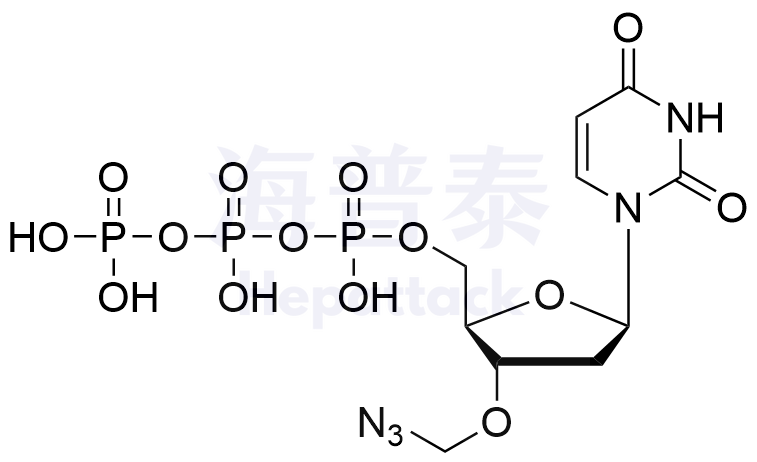
Chinese Name: 3′-O-Azidomethyl-2′-deoxyuridine 5′-triphosphate
English Name: 3′-O-Azidomethyl-dUTP
Abbreviation: 3′-O-N3-dUTP
CAS Number: 2400931-67-9
Molecular Formula: C10H16N5O14P3
Molecular Weight: 523.18
Specifications: 25 µl / 100 µl / 250 µl (Custom packaging supported)
Form: Aqueous solution
Concentration: 100 mM
Product Number: G09020005
To meet the high-standard substrate requirements for sequencing chemistry system development and nucleic acid labeling research, Hepattack Bioscience & Technology has launched a high-quality, high-purity 3′-O-azidomethyl-dNTP series.
This series covers all five bases (A, C, G, T, U), facilitating method development and performance evaluation in a unified system.
1. 3′-O-Azidomethyl dATP (CAS: 1048021-78-8)
2. 3′-O-Azidomethyl-dCTP (CAS: 1048021-94-8)
3. 3′-O-Azidomethyl-dGTP (CAS: 1048022-06-5)
4. 3′-O-Azidomethyl-dTTP (CAS: 1048021-85-7)
5. 3′-O-Azidomethyl-dUTP (CAS: 2400931-67-9)
IV. How does 3′-O-N3-dUTP achieve reversible termination?
The most notable feature of 3′-O-N3-dUTP is that its 3′-hydroxyl group is temporarily blocked by an azidomethyl group. Under the action of polymerase, this nucleotide can still be recognized and incorporated into the nascent DNA strand. However, because the 3′-OH is blocked, the DNA chain cannot continue to extend.
At this point:
1. A single base is incorporated
2. The system completes signal acquisition
3. The 3′ blocking group is removed
4. The natural 3′-OH is restored
5. The next round of polymerization begins
The entire process forms a cycle of:
Incorporation → Termination → Detection → Deprotection → Re-extension
Studies have shown that the 3′-O-Azidomethyl blocking group can be removed under mild reducing conditions such as TCEP, restoring the natural DNA structure and providing an extension basis for subsequent polymerization reactions. Compared to many modification systems that require retaining linker residues, this route leaves no residual modification after deprotection, avoiding the accumulation of modifications that could affect reaction efficiency over consecutive sequencing cycles.
V. Application Value of 3′-O-N3-dUTP
1. NGS reversible termination sequencing
Used for SBS sequencing system development, achieving single-base precise incorporation and cycle-by-cycle sequencing system construction, providing underlying chemical support for high-throughput sequencing.
2. Polymerase compatibility studies
Used to study polymerase recognition, incorporation, and extension of reversible terminator nucleotides, serving as a substrate evaluation tool for novel sequencing enzyme development. Typical uses include:
• Polymerase screening
• Enzyme engineering research
• Substrate compatibility evaluation
• Sequencing enzyme optimization development
Helping researchers evaluate polymerase recognition and incorporation of reversible terminator nucleotides.
3. Click chemistry labeling and probe design
Used for post-synthetic nucleic acid modification and labeling, enabling highly selective CuAAC reactions and efficient development of functional probes, applicable to nucleic acid labeling, probe construction, and related methodological studies.
VI. Why choose 3′-O-N3-dUTP?
✅ Traceless reduction, no modification residue
Deprotection conditions are mild and do not damage strands or enzymes, and no additional modifying structures remain after deprotection, avoiding the accumulation of modifications over multiple cycles.
✅ Small molecule blocking design, improved polymerase compatibility
The azidomethyl group is relatively small in size, facilitating polymerase recognition and incorporation, and can serve as an efficient reversible terminator substrate in sequencing reactions.
✅ Characteristic Raman signal, reduced background interference
The azide group has a characteristic signal peak in Raman spectroscopy, with no endogenous interference in biological systems, enabling low-background detection and adapting to non-fluorescent sequencing approaches such as SERS.
✅ Complete series, supporting supply
The domestically developed 3′-O-N3-dNTP series covers different base types, supporting in-stock supply and flexible selection during the R&D stage.

Extended Services
Precise termination, gentle recovery, supporting every step of cyclic sequencing.
For more "nucleotide raw materials" or custom packaging services, please call +86-13302967066!
Hepattack Bioscience & Technology is dedicated to providing reliable domestic alternative solutions for gene sequencing, molecular diagnostics, and microbial detection.
For related products such as blood cell dyes and buffer salts, you can view the complete product line and technical specifications on [MedSun Biotechnology Website].
Founded in 2015, it is a high-tech enterprise focusing on microbial testing、 gene sequencing and in vitro molecular diagnostics in the R&D, production, and sales of biochemical reagent raw materials. Committed to providing high-quality biochemical reagent raw materials and professional custom synthesis services, the product portfolio covers more than a dozen categories and nearly a thousand innovative products. Upholding the core philosophy of “customer first, integrity and professionalism”, we serve with dedication to meet customers’ diverse needs in research and testing.

Official WeChat account: Shenzhen Hepattack Bioscience & Technology Co. Ltd.
Official Website: http://www.hepattack.com
Hotline: +86 0755-23251735
QQ: 2370561481
Email: sales@hepattack.com
Related Links
- · FAQs about Hepattack BioTech [2025-01-20]
- · In Stock | Yeast Two-Hybrid Screening Made Easy — X-α-Gal Turns Positive Clones Blue [2026-09-09]
- · In Stock | Magenta-Gal: A Magenta β-D-Galactosidase Chromogenic Substrate for Instant Identification of Positive Clones [2026-09-11]
- · Hot Product | Principles and Applications of S-2366 (Pyr-Pro-Arg-pNA) for Coagulation Factor FXIa Activity Detection [2026-09-15]
- · In Stock | Rapid Visual Detection of Cronobacter in Infant Formula Milk Powder: Domestic X-α-Glc Solution [2026-09-18]
- · Double Holiday Approaching: Have You Arranged Your Orders? Hepattack Holiday & Shipping Notice [2026-09-22]
- · In Stock | Key Raw Material for Salmonella Chromogenic Media: Application Analysis of Magenta-Caprylate [2026-09-30]
- · In Stock | Hard to Tell Colony Morphologies Apart? Butyrate Esterase Detection Adds Another Discriminating Dimension [2026-10-10]