


Catalog Products

- News Center:
- Home>
- News Center>
- Company News>
- News Details
In-Stock Series | S-2238 Thrombin Chromogenic Substrate: Classic Sequence & Multiple Salt Forms for ATIII / Anti-IIa Assays
2026/5/28 15:07:41 Browse volume(359)S-2238
In the field of coagulation and fibrinolysis testing for in vitro diagnostics, the chromogenic substrate method has long been a mainstream clinical technique due to its high sensitivity, wide linear range, and excellent automation compatibility.
Looking through the literature, you will find that the entire field revolves around a few core substrates: S-2765 for FXa detection, S-2251 for plasmin detection, and when it comes to the specific determination of thrombin, one cannot avoid mentioning S-2238.
This molecule, born in the 1970s, remains a standard in countless laboratories. What makes it so special? Today, we will break down this "evergreen" in the field of coagulation testing.

S-2238 (chemical name: H-D-Phe-Pip-Arg-pNA) is one of the classic chromogenic substrates for thrombin. In the rapidly changing IVD raw material market, its lasting vitality stems from its ingenious underlying molecular design and extensive clinical and methodological validation.
Specifically, its "classic" status is reflected in the following three dimensions:
1. Ingenious mechanism: one reaction, two roles
S-2238 is essentially a chromogenic substrate used to monitor thrombin activity. Its structure simultaneously contains: a peptide sequence responsible for enzyme recognition and a pNA chromogenic group for generating the detection signal.
• Peptide moiety (H-D-Phe-Pip-Arg): This sequence is highly compatible with the catalytic active center of thrombin. It is efficiently and specifically recognized and cleaved by thrombin. This "specific recognition" characteristic allows it to maintain extremely high anti-interference ability even in complex plasma samples;
• Reporter group (pNA): After the peptide is cleaved, p-nitroaniline (pNA) is released, resulting in a significant increase in absorbance at 405 nm. The more pNA released in the system, the stronger the 405 nm absorbance signal, and the higher the corresponding thrombin activity. This makes enzyme activity changes visible, precise, and measurable;
2. Long-term validation: stable and reliable technical support
S-2238's classic status in the industry stems not only from its excellent enzymology design but also from years of validation in actual detection scenarios.
S-2238 substrate was applied early in clinical coagulation chromogenic assays and has been widely used in detection systems such as ATIII, anti-IIa, and thrombin activity analysis for decades. Numerous research papers, automated detection schemes, and commercial kits in the industry have built their detection methods based on this substrate.
The rich application data and technical accumulation provide strong technical support for reagent formulation replication, process optimization, and result traceability.
3. Flexible process: same sequence, multiple salt forms
All S-2238 substrates have identical peptide sequences, differing only in the counterion (hydrochloride/acetate) and its molarity. This does not change the enzymatic specificity of the substrate but profoundly affects key physicochemical indicators in kit development:
• Dissolution rate and solubility limit in aqueous solution
• Cake morphology and reconstitution behavior after lyophilization
• Potential perturbation of ionic strength and pH of the reaction system
• Long-term storage stability of liquid reagents
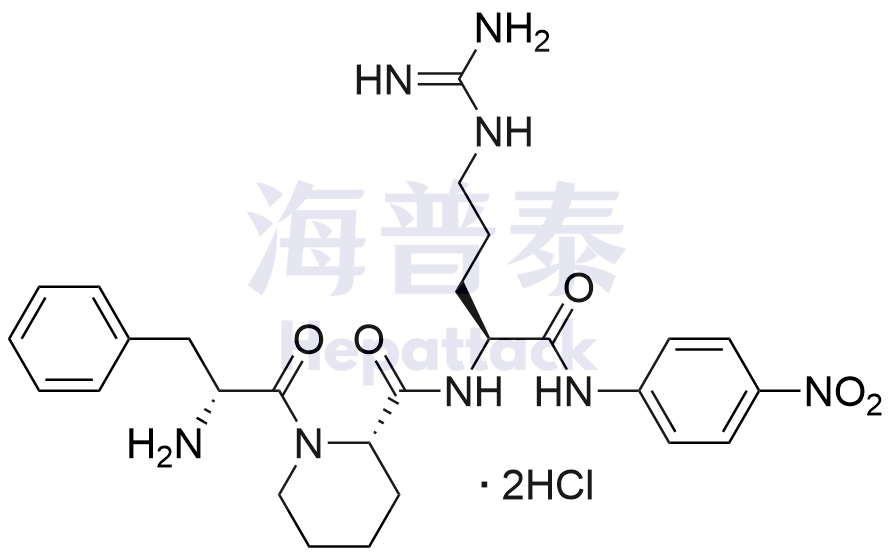
Chinese Name: Thrombin Chromogenic Substrate S-2238 Dihydrochloride
English Name: H-D-Phe-Pip-Arg-pNA ∙ 2HCl
Abbreviation: S-2238
CAS Number: 62354-65-8
Molecular Formula: C27H38Cl2N8O5
Molecular Weight: 625.55
Specifications: 25 mg / 100 mg / 500 mg (Custom packaging supported)
Form: Off-white crystalline powder
Product Number: G04010024
Stock: In stock
Color Signal: Yellow absorption at 405 nm
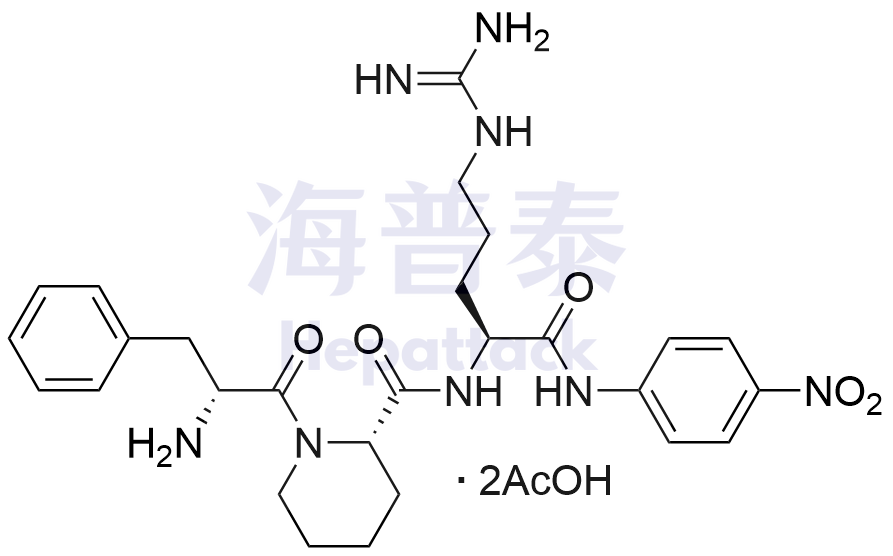
Chinese Name: Thrombin Chromogenic Substrate S-2238 Diacetate
English Name: H-D-Phe-Pip-Arg-pNA ∙ 2AcOH
Abbreviation: S-2238
CAS Number: 386253-60-7
Molecular Formula: C31H44N8O9
Molecular Weight: 672.74
Specifications: 25 mg / 100 mg / 500 mg (Custom packaging supported)
Form: Off-white crystalline powder
Product Number: G04010025
Stock: In stock
Color Signal: Yellow absorption at 405 nm
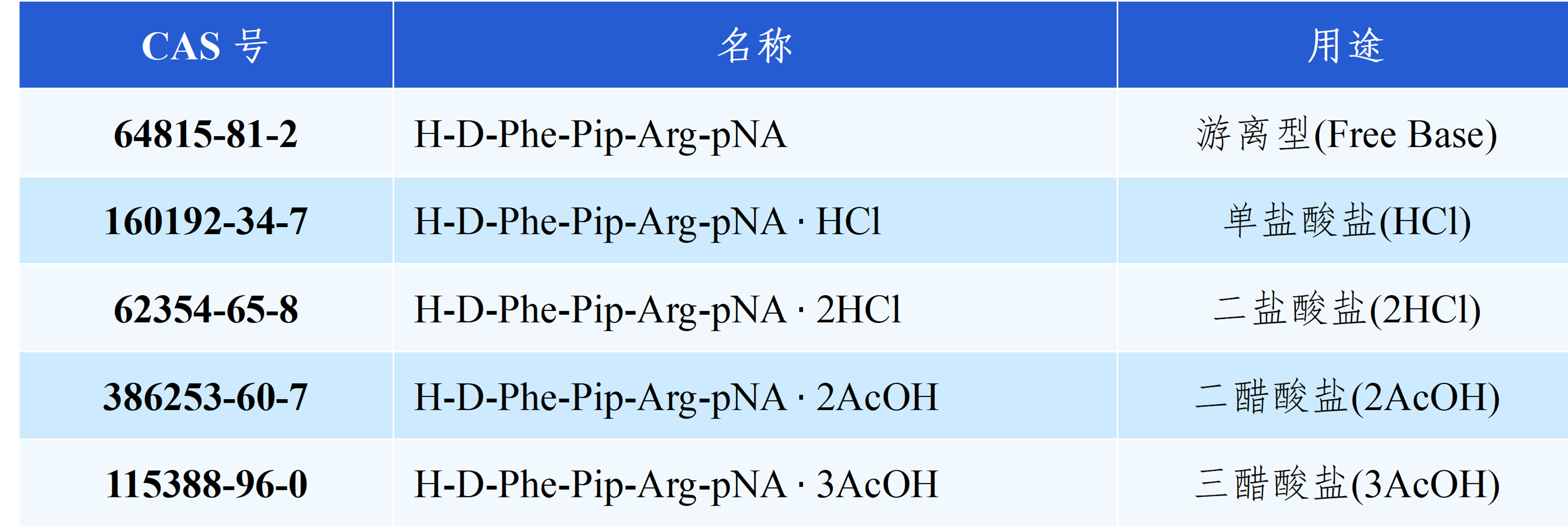
To adapt to different companies' buffer systems, solubility requirements, and production processes, we offer S-2238 products in 5 different salt forms and free base, providing more precise adaptation solutions and selection flexibility for your formulation development:
1. Antithrombin III (ATIII) chromogenic assay
S-2238 is one of the classic chromogenic substrates for thrombin and can be used in ATIII activity detection systems based on the "residual thrombin method". After ATIII reacts with thrombin, the remaining thrombin's ability to cleave S-2238 is measured to quantify ATIII activity. Suitable for:
• ATIII chromogenic assay development;
• Method establishment on automated coagulation platforms;
• Continuous kinetic detection systems;
• Clinical coagulation function research;
2. Heparin anti-IIa chromogenic detection system
Used in some anti-IIa heparin assays to monitor the inhibitory effect of heparin on thrombin activity. Helps in:
• Heparin activity analysis;
• Anti-IIa methodology development;
• Establishment of automated coagulation systems;
• Long-term stability validation;
✅ High purity control, helps reduce 405 nm background interference
The S-2238 series uses high-purity peptide synthesis and purification processes, which can reduce the impact of free pNA and some degradation impurities on 405 nm background absorption. In continuous kinetic detection systems such as ATIII and anti-IIa, this helps improve data stability in low enzyme activity ranges and reduces the interference of blank well background drift on the standard curve.
✅ Sequence design tailored to thrombin recognition characteristics
Based on thrombin's highly selective cleavage preference for the D-Phe-Pip-Arg sequence, the S-2238 series adopts this classic sequence design, offering high recognition selectivity for thrombin, thereby reducing potential interference from other serine proteases in the detection system. It can be used for anti-IIa methodology development and continuous kinetic analysis of thrombin, making it more suitable for clinical coagulation monitoring and cleavage mechanism studies.
✅ Excellent batch-to-batch consistency, ensuring reagent stability
Each batch of substrate undergoes rigorous kinetic curve determination and quality control. Excellent batch-to-batch consistency ensures the long-term stability of the kit's calibration curve, effectively reducing the risk of quality control fluctuations caused by substrate batch changes.
✅ Multiple salt forms adaptable to different development stages
To meet the different needs of research development, automated platforms, and IVD process systems, Hepattack Bioscience & Technology offers various salt forms including free base, HCl salt, and AcOH salt. In some systems, this can help improve solution stability, reduce the risk of precipitation at low temperatures, and enhance method consistency under long-term storage conditions.
✅ High cost-effectiveness, domestic in-stock supply
Common specifications (25 mg, 100 mg, 500 mg) are available for immediate shipment. Relying on in-house R&D and production, we eliminate additional cost factors such as cross-border transportation, agent distribution, and tariffs, offering outstanding price advantages and helping enterprises effectively control raw material procurement costs.

Extended Services
Classic thrombin substrate, flexible salt form adaptation – Hepattack S-2238 series
For more "coagulation test chromogenic substrates" or custom services, please call +86-13302967066!
Hepattack Bioscience & Technology is dedicated to providing reliable domestic alternative solutions for gene sequencing, molecular diagnostics, and microbial detection.
For related products such as blood cell dyes and buffer salts, you can view the complete product line and technical specifications on [MedSun Biotechnology Website].
Founded in 2015, it is a high-tech enterprise focusing on microbial testing、 gene sequencing and in vitro molecular diagnostics in the R&D, production, and sales of biochemical reagent raw materials. Committed to providing high-quality biochemical reagent raw materials and professional custom synthesis services, the product portfolio covers more than a dozen categories and nearly a thousand innovative products. Upholding the core philosophy of “customer first, integrity and professionalism”, we serve with dedication to meet customers’ diverse needs in research and testing.

Official WeChat account: Shenzhen Hepattack Bioscience & Technology Co. Ltd.
Official Website: http://www.hepattack.com
Hotline: +86 0755-23251735
QQ: 2370561481
Email: sales@hepattack.com
Related Links
- · FAQs about Hepattack BioTech [2025-01-20]
- · In Stock | Yeast Two-Hybrid Screening Made Easy — X-α-Gal Turns Positive Clones Blue [2026-09-09]
- · In Stock | Magenta-Gal: A Magenta β-D-Galactosidase Chromogenic Substrate for Instant Identification of Positive Clones [2026-09-11]
- · Hot Product | Principles and Applications of S-2366 (Pyr-Pro-Arg-pNA) for Coagulation Factor FXIa Activity Detection [2026-09-15]
- · In Stock | Rapid Visual Detection of Cronobacter in Infant Formula Milk Powder: Domestic X-α-Glc Solution [2026-09-18]
- · Double Holiday Approaching: Have You Arranged Your Orders? Hepattack Holiday & Shipping Notice [2026-09-22]
- · In Stock | Key Raw Material for Salmonella Chromogenic Media: Application Analysis of Magenta-Caprylate [2026-09-30]
- · In Stock | Hard to Tell Colony Morphologies Apart? Butyrate Esterase Detection Adds Another Discriminating Dimension [2026-10-10]